Stamp Duty Buy to Let Calculator
See stamp duty land tax band by band, with and without the 5% surcharge for an additional dwelling.
Free · runs in your browser · nothing is uploaded
How to use the stamp duty buy to let calculator
- Enter the Purchase price in pounds. The example is £250,000.
- Tick Buying an additional dwelling (5% surcharge) if you already own another residential property, or if this purchase will be one. Leave it unticked to see the standard rates only.
- Read the Stamp Duty Land Tax line, which shows the amount in pounds and as a percentage of the price.
- Compare the stamp duty without the surcharge with the surcharge for an additional dwelling to see how much of the total the surcharge adds.
- Check the band table to see which rate applies to each part of the price.
- Change the Purchase price to test other prices. The table of seven prices in the explain section gives a quick reference.
- Read the spread over 12 months line only if you want the total divided by twelve. It is arithmetic, not a payment plan.
- Confirm the rates on the GOV.UK page before you rely on the result, because rates can change.
The results update live as you type. Under the tool there are buttons for Reset to examples, Copy summary, Download CSV and Print or save as PDF. The page address holds your inputs, so a link you share recreates the same result.
Change one input at a time to see which result moves. The address bar keeps your inputs, so you can bookmark or share a scenario. Reset to examples restores the example values.
What does the stamp duty buy to let calculator give you?
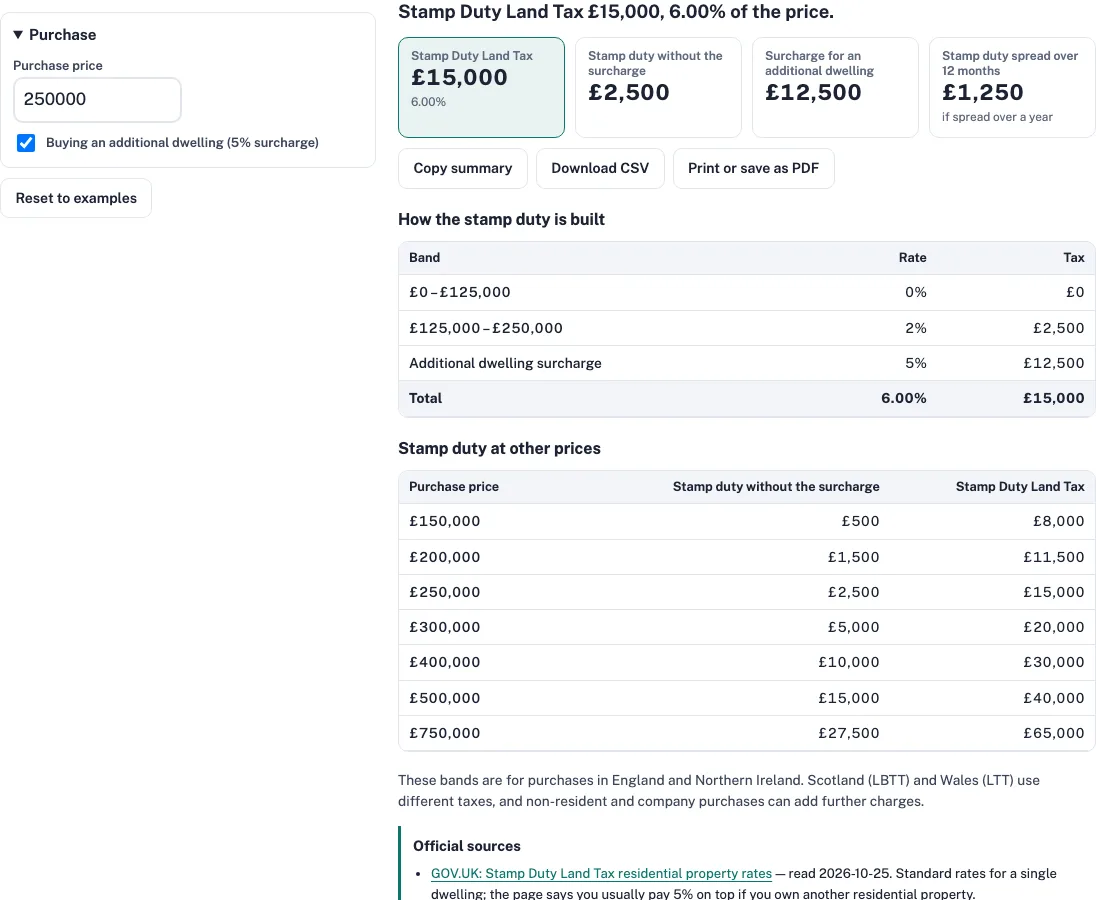
It gives the Stamp Duty Land Tax on one residential purchase. At £250,000 with the additional dwelling box ticked, the answer is £15,000, which is 6.00% of the price. Without the surcharge, the same purchase pays £2,500.
How the stamp duty is built, band by band
The bands below are from GOV.UK, read on 2026-10-25. The standard rates are 0% up to £125,000, 2% from £125,001 to £250,000, 5% from £250,001 to £925,000, 10% from £925,001 to £1.5m and 12% above £1.5m. GOV.UK says you usually pay 5% on top if you own another residential property. This tool works the surcharge out as 5% of the whole price.
| Band | Rate | Tax |
|---|---|---|
| £0 – £125,000 | 0% | £0 |
| £125,000 – £250,000 | 2% | £2,500 |
| Additional dwelling surcharge | 5% | £12,500 |
| Total | 6.00% | £15,000 |
What does stamp duty cost at other prices?
The same bands give these results. Each row is the standard tax, then the total with the surcharge, which is 5% of the price added.
| Purchase price | Stamp duty without the surcharge | Stamp Duty Land Tax |
|---|---|---|
| £150,000 | £500 | £8,000 |
| £200,000 | £1,500 | £11,500 |
| £250,000 | £2,500 | £15,000 |
| £300,000 | £5,000 | £20,000 |
| £400,000 | £10,000 | £30,000 |
| £500,000 | £15,000 | £40,000 |
| £750,000 | £27,500 | £65,000 |
What is the formula behind the stamp duty figure?
For prices from £250,000 to £925,000, the standard tax is £2,500 plus 5% of the amount above £250,000. The surcharge adds 5% of the whole price. In symbols, with P as the price: standard tax = £2,500 + 0.05 × (P - £250,000), and total = standard tax + 0.05 × P. For a £400,000 purchase, the standard tax is £2,500 + 0.05 × £150,000 = £10,000, and the surcharge is 0.05 × £400,000 = £20,000, so the total is £30,000.
Which costs does this calculator not cover?
The bands apply to purchases in England and Northern Ireland. Scotland (LBTT) and Wales (LTT) use different taxes. The calculator does not include the non-resident surcharge, company purchases, first-time buyer relief or other reliefs. It is not a figure for leases or tenancy agreements either. Use GOV.UK for those.
How much cash does stamp duty add to a buy-to-let purchase?
Stamp duty is paid on completion on top of the deposit and the legal fees, so it raises the cash you must have before you can buy. At the example price of £250,000 the duty is £15,000, which is 6.00% of the price: £2,500 from the standard bands plus the £12,500 surcharge. With a 25% deposit of £62,500, the cash for deposit and stamp duty alone is £62,500 + £15,000 = £77,500, before solicitor, survey and mortgage fees.
The surcharge is the larger part of the bill at this price, which is why the “Buying an additional dwelling (5% surcharge)” box matters. Untick it to see the standard figure, for example when you are replacing your only home. Stamp duty is also a one-off cost that the first-year yield does not show, so a buy-to-let that looks fine on rent alone can have a low return on the cash you actually put in. The buy-to-let calculator adds this tax to the cash invested and then shows cash flow after income tax and the lender interest cover test.
Frequently asked questions
What is the formula for calculating Stamp Duty?
For a residential purchase in England and Northern Ireland priced from £250,000 to £925,000, the standard tax is £2,500 plus 5% of the price above £250,000. With the additional dwelling surcharge, add 5% of the whole price. At £250,000 the total is £15,000. Check the result against the GOV.UK bands before you rely on it.
What is the formula for calculating Stamp Duty in Excel for 2026?
Put the price in cell A1 and 1 or 0 in cell B1 for the surcharge. Then use =0.02MIN(MAX(A1-125000,0),125000)+0.05MAX(A1-250000,0)+0.05A1B1. It works up to £925,000. The bands are those GOV.UK showed when read on 2026-10-25, so check them if the figures have changed.
What is the Stamp Duty rate for a tenancy agreement in 2026?
This page covers Stamp Duty Land Tax on residential purchases only. It does not cover the duty on leases or tenancy agreements, so no rate is given here. Check the current rate on GOV.UK.
How to avoid stamp duty on buy to let?
This page does not give advice on avoiding tax. GOV.UK sets out reliefs that exist for some situations, with the conditions for each. A qualified tax adviser can tell you whether any apply to your purchase.
How much stamp duty do I pay on a second home?
With the additional dwelling box ticked, the tool adds 5% of the whole price to the standard bands. At £250,000 the total is £15,000 (6.00%), compared with £2,500 without the surcharge. GOV.UK says you usually pay that 5% on top if you already own another residential property.
How much stamp duty on a £400,000 house?
For £400,000, the standard bands give £10,000. With the additional dwelling surcharge of £20,000 (5% of £400,000) added, the total is £30,000. The calculator does not apply first-time buyer relief, so a relief case will show a different bill.
How much stamp duty is there in Wales?
This calculator covers England and Northern Ireland only. Wales uses Land Transaction Tax (LTT) and Scotland uses LBTT, so the tool gives no figure for a Welsh purchase. Check the Welsh rates with the official source before you rely on any figure.
Related tools
- buy to let calculator: use it for yield, tax and the lender test on the same purchase.
- rental yield calculator uk: use it for yield on its own.
- rental property calculator: use it for a projection over time.
- cash on cash return calculator: use it to see the return on your cash, including this tax.
- dscr calculator: use it for loan coverage.
- cap rate calculator: for the return on the property before any loan.