Buy to Let Calculator
Work out stamp duty, yield, cash flow after tax and the lender interest cover test for a UK buy-to-let.
Free · runs in your browser · nothing is uploaded
How to use the buy to let calculator
- Enter the Purchase price in pounds. The example is £250,000.
- Enter Legal, survey and mortgage fees. Tick Buying an additional dwelling (5% surcharge) if the home you are buying is a second residential property in England or Northern Ireland.
- Set the Down payment and Interest rate as percentages, then the Loan term (years). Tick Interest-only loan if the mortgage is interest-only.
- Enter the Monthly rent you expect, and Vacancy as the percentage of rent you lose to empty months.
- Enter the yearly costs: Property tax per year, Insurance per year and Service charge and ground rent per year.
- Enter Letting agent fee (% of rent) and Maintenance (% of rent) as percentages.
- Enter Your marginal income tax rate as a percentage. The example of 40 is only an example, so use the rate that applies to you.
- Optionally enter Income above the personal allowance (optional). Leave it blank if you do not know it.
- Enter the Lender stress-test rate and Required interest cover (rent / interest) from your lender. The example values of 5.5 and 125 are not a lender’s rules.
- Read the results, then change one input at a time to see its effect.
The results update live as you type. Under the tool there are buttons for Reset to examples, Copy summary, Download CSV and Print or save as PDF. The page address holds your inputs, so a link you share recreates the same result.
What does the buy to let calculator tell you?
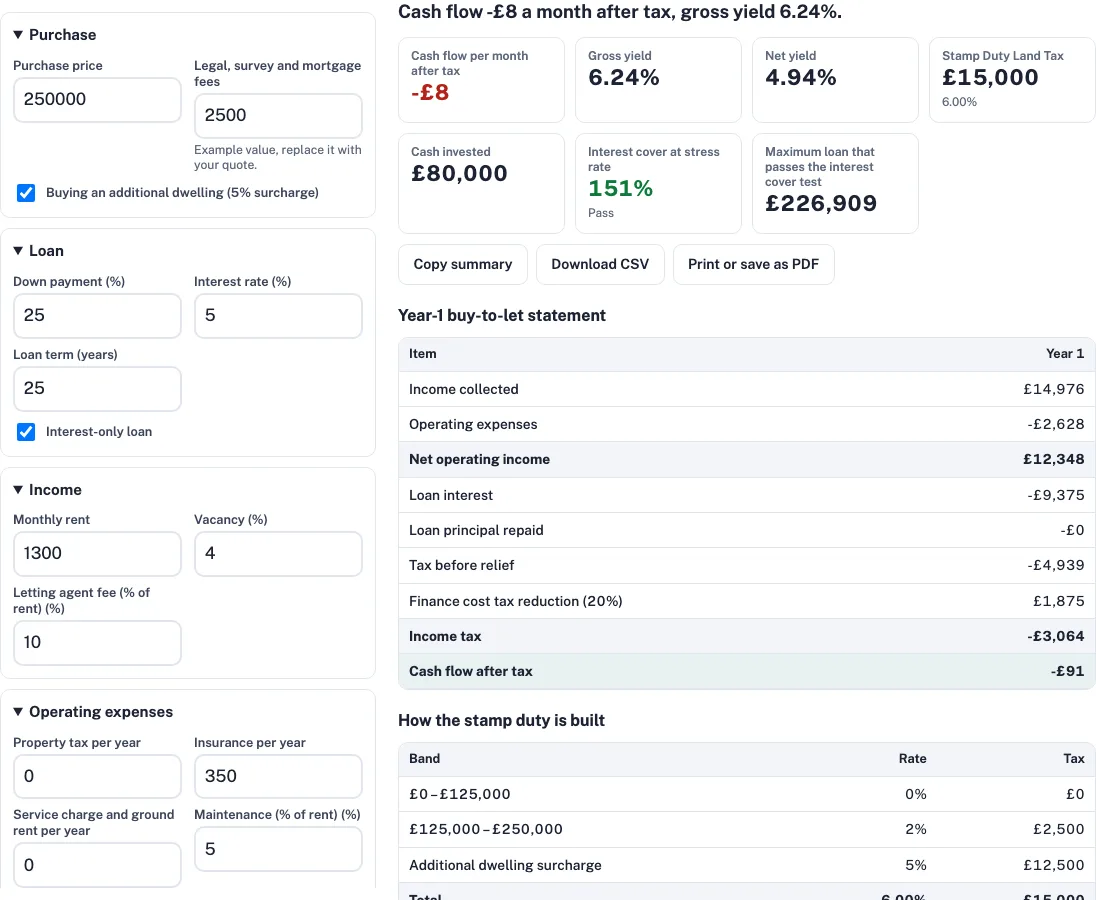
It works out the one-off purchase tax, the year-1 cash flow after income tax, the yields and the lender test for one property. With the example inputs, the cash flow is -£8 a month after tax, the gross yield is 6.24%, and the interest cover is 151%, which passes a 125% requirement. The example also needs £80,000 of cash.
| Item | Year 1 |
|---|---|
| Income collected | £14,976 |
| Operating expenses | -£2,628 |
| Net operating income | £12,348 |
| Loan interest | -£9,375 |
| Loan principal repaid | -£0 |
| Tax before relief | -£4,939 |
| Finance cost tax reduction (20%) | £1,875 |
| Income tax | -£3,064 |
| Cash flow after tax | -£91 |
How the stamp duty is built, band by band
Stamp Duty Land Tax on residential purchases in England and Northern Ireland uses bands on GOV.UK, read on 2026-10-25: 0% up to £125,000, 2% from £125,001 to £250,000, 5% from £250,001 to £925,000, 10% from £925,001 to £1.5m and 12% above that. GOV.UK says you usually pay 5% on top if you own another residential property. For the example, 2% of £125,000 is £2,500, and the 5% surcharge on £250,000 is £12,500. The total is £15,000, or 6.00% of the price.
How Section 24 changes the tax on a buy-to-let
Finance costs, such as loan interest, are no longer deducted from rent. Instead, the tax bill is reduced by 20% of the lowest of three figures: finance costs, property profits and adjusted total income above the personal allowance. The third figure applies only if you enter that income. In the example, 20% of the £9,375 interest is £1,875.
| Rule | Taxable figure | Income tax at 40% |
|---|---|---|
| Old rule: profit after interest (£12,348 - £9,375) | £2,973 | £1,189 |
| Section 24: tax before relief | £12,348 | £4,939 |
| Section 24: after the 20% credit (£4,939 - £1,875) | £12,348 | £3,064 |
The tool applies your marginal rate to the whole net operating income. The difference between the old and new rules is £3,064 - £1,189 = £1,875 a year. This is an estimate that depends on the rate you enter, so check your own position with a qualified adviser.
What does the interest cover test check?
Interest cover is rent divided by the loan’s interest at the stress rate. For the example, annual rent of £15,600 divided by £187,500 x 5.5% (£10,312.50) gives 151%. The required cover is 125%, so the loan passes. The largest loan that passes is £15,600 ÷ 1.25 = £12,480 of interest, then £12,480 ÷ 5.5% = £226,909. The stress rate and required cover are lender rules, so replace the example values with your lender’s.
Interest-only or repayment: what changes?
The example is interest-only, so no principal is repaid in year 1. A repayment loan adds capital repayments to the yearly payment, which lowers cash flow, and the interest part shrinks as the balance falls. Tick the interest-only box to compare the two.
What does the calculator leave out?
It covers England and Northern Ireland only. Scotland (LBTT) and Wales (LTT) have different taxes and are not covered. It does not include the non-resident surcharge, company purchases, first-time buyer relief or other reliefs, capital gains on a sale, or your lender’s own affordability policy. Void periods are modelled only as the vacancy percentage. Costs without an input box are not included.
Is buy to let still worth it in the UK?
The calculator cannot answer that for you. It gives a number for one purchase, using the inputs you enter. Compare the net yield and the cash flow with what the same money would earn elsewhere, and test the numbers with your own costs and your lender’s terms.
Frequently asked questions
How is buy to let mortgage affordability calculated?
Lenders usually check that the rent covers the interest at a stress rate. This tool divides the annual rent by the loan times the stress rate and compares the result with the required cover. Lender rules differ, so the result is an estimate, not a lender’s decision.
Is buy to let still worth it in the UK?
The numbers decide that for each property. Enter the figures for one purchase and look at the cash flow after tax, the yields and the interest cover result.
Does the calculator include stamp duty in Scotland or Wales?
No. Scotland uses LBTT and Wales uses LTT, and both differ from the England and Northern Ireland bands used here. Check the official rates for those nations.
Should I choose interest-only or repayment?
That depends on your plans, your lender’s offer and your tax position. The calculator lets you compare both. Discuss the choice with your lender and a qualified adviser before you decide.
Is the 5% surcharge always charged?
The tool adds it when you tick the additional dwelling box. GOV.UK sets out the rules for when it applies and when other reliefs may change the result, so check those rules for your purchase.
How much can I borrow on a buy to let mortgage?
The calculator shows the largest loan that passes its interest cover test, using the rent, stress rate and required cover you enter. With the example figures (rent of £15,600, stress rate 5.5% and cover of 125%), the largest loan is £226,909. This is a lender-rule estimate, not a lending decision, so replace the example stress rate and cover with your lender’s figures.
How much stamp duty will I pay on a buy to let?
Stamp duty depends on the price and on the additional dwelling box. At £250,000 with the box ticked, the tool shows £15,000, which is 6.00% of the price. Without the surcharge, the same price pays £2,500.
Related tools
- stamp duty buy to let calculator: use it for the stamp duty alone at any price.
- rental yield calculator uk: use it for gross and net yield on their own.
- rental property calculator: use it for a long-term projection in pounds.
- dscr calculator: use it for the US-style coverage ratio.
- cap rate calculator: use it for the unlevered return.
- cash on cash return calculator: use it for the return on your deposit.