Rental ROI Calculator
Split the first-year return on your cash into cash flow, loan paydown and value growth, and see IRR over your hold.
Free · runs in your browser · nothing is uploaded
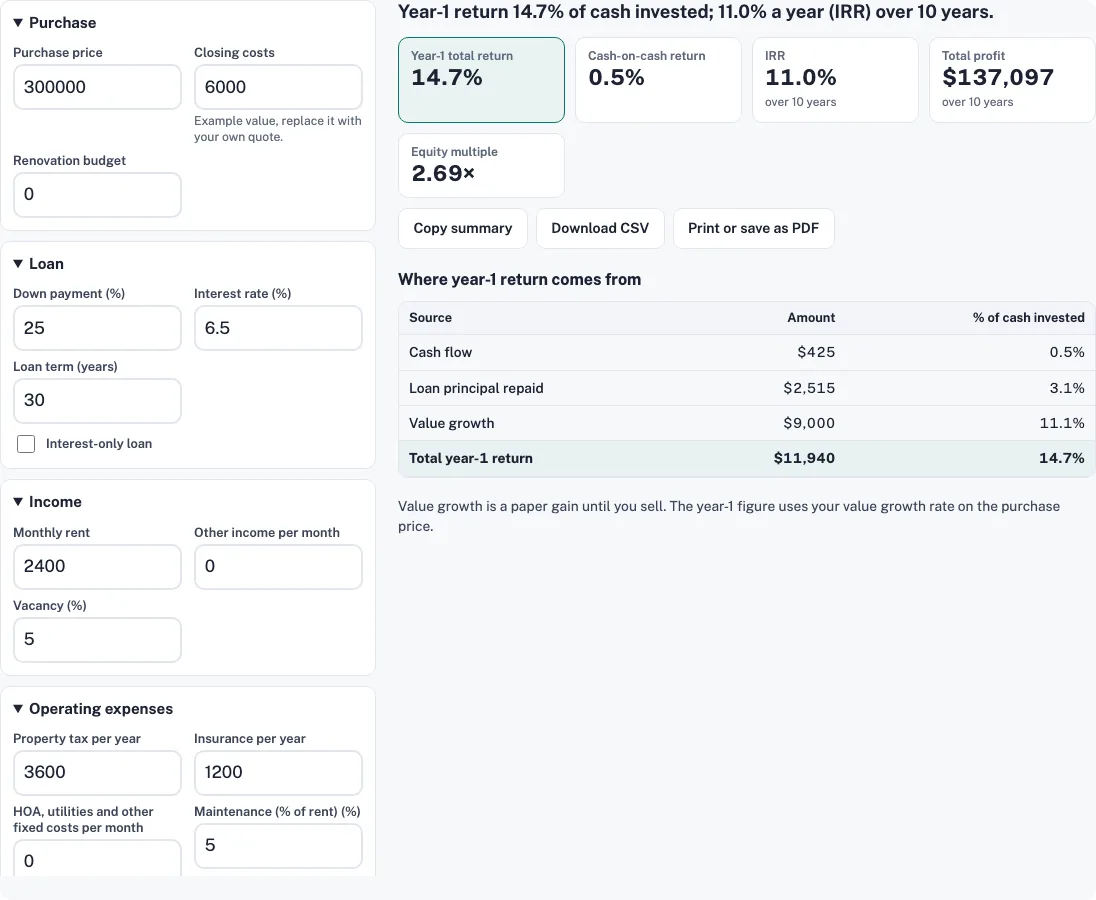
How to use the rental ROI calculator
- Enter the Purchase price and the Closing costs you expect at purchase.
- Enter a Renovation budget only if you plan work before renting. Otherwise leave it at 0.
- Set the Down payment as a percentage, then enter the Interest rate, Loan term (years) and whether the loan is an Interest-only loan.
- Enter Monthly rent, Other income per month and Vacancy (the share of rent you expect to lose).
- Enter Property tax per year, Insurance per year and HOA, utilities and other fixed costs per month.
- Set Maintenance (% of rent), Capital expenses (% of rent) and Property management (% of collected rent).
- Set Rent growth per year, Expense growth per year and Value growth per year.
- Enter Selling costs and Years you hold it.
- Read the year-1 return, then the source table and the total profit.
The results update as you type. Reset to examples puts back the default numbers, and Copy summary, Download CSV and Print or save as PDF give you the result in other forms. The page address holds your inputs, so a link you share recreates the same result.
Change one input at a time to see which result moves. The address bar keeps your inputs, so you can bookmark or share a scenario. Reset to examples restores the example values.
What is the rental ROI formula?
Rental ROI equals cash flow plus principal repaid plus value growth, divided by cash invested. Cash invested is the down payment plus closing costs and renovation. The example’s down payment is 25% of $300,000, or $75,000, and closing costs add $6,000, so cash invested is $81,000. Year 1 adds $425 of cash flow, $2,515 of principal and $9,000 of value growth, which is $11,940. Divided by $81,000, that is 14.7%.
Where the year-1 return comes from
| Source | Amount | % of cash invested |
|---|---|---|
| Cash flow | $425 | 0.5% |
| Loan principal repaid | $2,515 | 3.1% |
| Value growth | $9,000 | 11.1% |
| Total year-1 return | $11,940 | 14.7% |
Cash flow is the money left after rent, costs and loan payments. Principal repaid is the part of the loan payments that reduces the balance. Value growth is 3% of the $300,000 purchase price. It is a paper gain until you sell, so most of the 14.7% is not cash in hand.
Why does ROI differ from cash-on-cash and cap rate?
Cash-on-cash return counts only cash flow, so the example shows 0.5%. A cap rate ignores the loan entirely. ROI adds the principal you repay and the value growth, so it is the widest of the three measures. Use the cash on cash return calculator for the cash-only view and the cap rate calculator for the unlevered view.
How much profit and what IRR do you get over the hold?
Over the 10 years you set, the example makes a total profit of $137,097, which is the money you keep after getting back the $81,000 invested. The equity multiple is 2.69×, meaning the total cash back is 2.69 times the cash invested. IRR is 11.0% a year. IRR counts when the cash arrives, so money received early is weighted more. The IRR depends on the value growth and selling cost inputs, so test different values before you rely on it.
What is a good ROI for renting?
There is no fixed number that makes a rental ROI good. It depends on the risk you take, the leverage you use and what your cash could earn in a safer place. Set a target from that comparison, then change the inputs and see whether the deal still meets it. The year-1 figure includes unrealised value growth, so compare it with a total return over the full hold.
How do I calculate ROI on a rental property step by step?
Start with cash invested: $75,000 down plus $6,000 closing gives $81,000. Add the year-1 cash flow of $425, the principal repaid of $2,515 and the value growth of $9,000, which totals $11,940. Divide $11,940 by $81,000 to get 14.7%. Then check the IRR over the full hold, because a single year does not show the sale.
What do the 2% and 7% rules say?
They are quick screens, not ROI results. The 2% rule asks whether monthly rent is 2% of the price. The example rents for $2,400 a month on $300,000, which is 0.8%. The 7% rule asks whether annual rent is 7% of the price. The example’s $28,800 a year is 9.6% of $300,000. Neither screen includes the loan, vacancy or costs, so use the ROI table above for the detail.
Frequently asked questions
Frequently asked questions
How do you calculate ROI on a rental property?
Add the year’s cash flow, the principal you repaid and the value growth, then divide by the cash invested. The example gives $11,940 ÷ $81,000, or 14.7%.
What is the 2% rule for rental income?
It is a quick screen that asks whether monthly rent is 2% of the purchase price. The example is 0.8%, so it does not pass that screen. The screen ignores loan terms and costs.
What is the 7% rule for rental property?
It is a quick screen that asks whether annual rent is 7% of the purchase price. The example is 9.6%. Use it as a first check only, and use the year-1 return and IRR for the detail.
What is a good ROI for renting a property?
It depends on your risk, your leverage and the return on a safer alternative. Set your own target by comparing the total return with that alternative, then test the inputs against it.
What do the inputs and outputs mean?
Cash invested is the down payment, plus closing costs and any renovation budget. The year-1 return adds cash flow, the loan principal you repay and value growth, then divides by cash invested. Total profit, the equity multiple and IRR cover the whole hold you set, which is 10 years in the example.
How do I estimate cash flow on a rental property?
Cash flow is the money left after rent, costs and loan payments. Enter the monthly rent, other income and vacancy, then the tax, insurance, fixed costs, maintenance, capital expenses and management that the tool deducts, along with the loan. In the default example, year-1 cash flow is $425, which gives the 0.5% cash-on-cash figure.
Does this calculator also calculate cap rates?
No. This page measures the return on your cash, including loan principal and value growth, and it does not show a cap rate. A cap rate ignores the loan, so use the cap rate calculator for that unlevered view.
Related tools
- cash on cash return calculator: use it for the cash-only measure.
- cap rate calculator: use it for the unlevered measure.
- rental property calculator: use it for the year-by-year table.
- rent vs buy calculator: use it to compare owning with renting and investing.
- investment property calculator: use it to compare two properties.
- BRRRR calculator: use it for recycling cash.