Price to Rent Ratio Calculator
Divide the price by a year of rent, then compare the monthly cost of owning with the rent on the same home.
Free · runs in your browser · nothing is uploaded
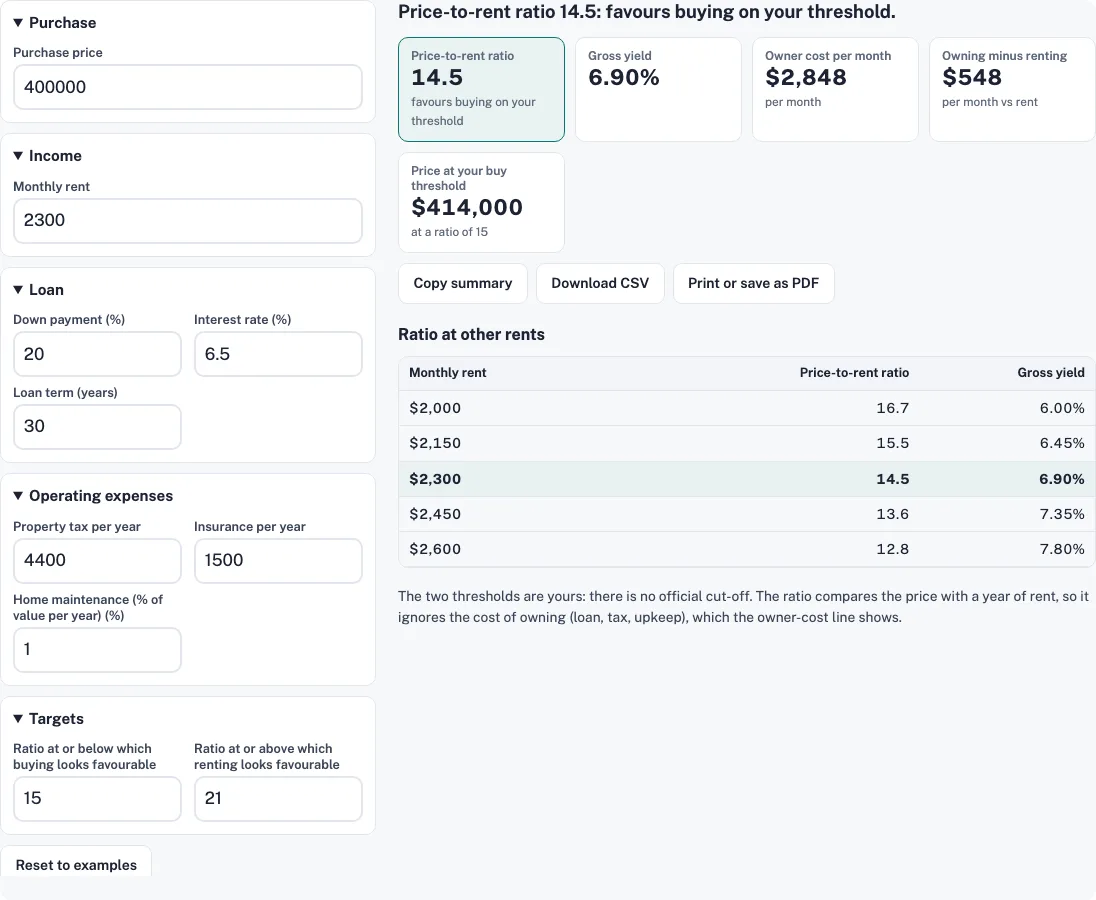
How to use the price to rent ratio calculator
- Enter the Purchase price of the home. The example is $400,000.
- Enter the Monthly rent you expect to collect. The example is $2,300.
- Enter the Down payment as a percentage of the price. The example is 20.
- Enter the Interest rate and the Loan term (years) for the mortgage. The examples are 6.5 and 30.
- Enter the Property tax per year and the Insurance per year in dollars. The examples are $4,400 and $1,500.
- Enter Home maintenance (% of value per year). The example is 1, which means 1% of the price each year.
- Enter Ratio at or below which buying looks favourable. The example is 15.
- Enter Ratio at or above which renting looks favourable. The example is 21.
- Read the headline, then the Price-to-rent ratio, Owner cost per month and Owning minus renting lines.
- Check the table Ratio at other rents to see the ratio at rents $300 above and below yours.
The results update as you type. The buttons Reset to examples, Copy summary, Download CSV and Print or save as PDF restore the example inputs, copy the summary, save the figures as a CSV file and make a printable page. The page address holds your inputs, so a link to it recreates the same result.
Change one input at a time to see which result moves. The address bar keeps your inputs, so you can bookmark or share a scenario. Reset to examples restores the example values.
What is the price to rent ratio formula?
The price to rent ratio divides the purchase price by one year of rent. In words, it is the purchase price divided by the monthly rent times 12. In symbols, ratio = P / (R × 12). With the example inputs, $400,000 / ($2,300 × 12) = $400,000 / $27,600 = 14.5.
The ratio is the inverse of gross yield. Gross yield is annual rent divided by price: $27,600 / $400,000 = 6.90%, which the tool shows as Gross yield. Gross yield counts rent before any costs.
What is a good price to rent ratio?
No official cut-off exists. Some guides quote rules of thumb, but this calculator does not pick a winner for you. It compares your ratio with the two thresholds you enter: Ratio at or below which buying looks favourable (example 15) and Ratio at or above which renting looks favourable (example 21). The 15 and 21 are examples only.
With the example thresholds, a ratio of 14.5 reads “favours buying on your threshold”. Change either threshold and the same ratio can read differently. Set thresholds that fit your market, your loan and how long you plan to stay, and check them against recent sales and rentals near the property.
Ratio at other rents
The table keeps the price at $400,000 and changes only the monthly rent. A rent $300 above the example gives a ratio of 12.8 and a gross yield of 7.80%. A rent $300 below it gives 16.7 and 6.00%.
| Monthly rent | Price-to-rent ratio | Gross yield |
|---|---|---|
| $2,000 | 16.7 | 6.00% |
| $2,150 | 15.5 | 6.45% |
| $2,300 | 14.5 | 6.90% |
| $2,450 | 13.6 | 7.35% |
| $2,600 | 12.8 | 7.80% |
Higher rent lowers the ratio, because the same price is set against more rent.
What does the price to rent ratio leave out?
The ratio leaves out the cost of owning. The loan, property tax, insurance and upkeep are not in it. The owner cost line adds them. Upkeep is 1% of $400,000, which is $4,000 a year. Property tax, insurance and upkeep add up to $4,400 + $1,500 + $4,000 = $9,900 a year, or $825 a month. The loan payment makes up the rest of the Owner cost per month of $2,848.
Subtract the $2,300 rent and owning costs $548 a month more than renting, which the tool shows as Owning minus renting. The ratio also ignores price changes over time and how long you stay. The 50/30/20 rule is a budgeting rule for splitting income, so this page does not cover it.
What is the 2% rule for rentals?
The 2% rule is a quick screen. It asks whether monthly rent is at least 2% of the purchase price. For a $400,000 house, 2% is $8,000 a month. The example rent of $2,300 is 0.575% of the price ($2,300 / $400,000), well below that screen. Like the ratio, the screen does not count loan or running costs. For the 1% version, see the 1% rule calculator.
How much should rent be on a $400,000 house?
It depends on the ratio you choose. Rearranged, the formula is rent = price / ratio / 12. At your buy threshold of 15, the rent that gives a ratio of 15 is $400,000 / 15 / 12 = $2,222 a month. At the renting threshold of 21, it is $400,000 / 21 / 12 = $1,587 a month. These are ratio results, not market rents, so check recent rentals near the property before you rely on them.
Frequently asked questions
What is a good price to rent ratio?
There is no official cut-off. The tool compares your ratio with the two thresholds you enter, and the example values of 15 and 21 are examples, not market data. Pick thresholds from your own local rentals and sales.
What is the 2% rule for rentals?
It is a quick screen that asks whether monthly rent is at least 2% of the price. For a $400,000 house that is $8,000 a month. It does not count loan payments, taxes or upkeep, so treat it as a first check rather than a full test.
How much should rent be on a $400,000 house?
It depends on the ratio you choose. Rent = $400,000 / ratio / 12, which gives $2,222 a month at a ratio of 15 and $1,587 a month at 21.
Does the price to rent ratio include the loan?
No. The ratio uses only the price and the rent. The owner cost line adds the loan payment, property tax, insurance and upkeep, and shows $2,848 a month with the example inputs.
What is the 50/30/20 rule for rent?
It is a budgeting rule for splitting income between needs, wants and savings. It is not a rental return measure, so this calculator does not cover it. Use the price to rent ratio for the property itself and a budget rule for your household spending.
How does the price-to-rent ratio differ from the cap rate?
The price-to-rent ratio divides the price by one year of gross rent, so it counts rent before any costs. The cap rate subtracts operating costs, though not the loan payment, before dividing by the price, so it shows the return after running costs. The price-to-rent ratio is the simpler screen, and the cap rate calculator gives the after-cost figure.
Can I use the price-to-rent ratio for a multi-unit property?
Yes. Add the rent from every unit and enter the total as the Monthly rent. The ratio then divides the price by twelve times that total, so the result covers the whole building.
Should I ignore the price-to-rent ratio if the market has strong appreciation?
The ratio does not count appreciation, so it cannot show the value of price gains. It uses today’s price and one year of rent, and it ignores price changes over time. Decide how much weight to give expected price growth yourself, and check the ratio against your own rent and sale records.
Related tools
- rent vs buy calculator: use it for a full comparison of renting and buying over the years.
- gross rent multiplier calculator: use it for the same idea from the landlord side.
- 1 percent rule calculator: use it to test monthly rent as a share of the price.
- cap rate calculator: use it for the return after operating costs.
- rental property calculator: use it for a full cash flow projection.
- rental income calculator: use it to work out the rent you need.