Gross Rent Multiplier Calculator
Get the GRM and gross yield from price and rent, and value a property from the GRM of comparable sales.
Free · runs in your browser · nothing is uploaded
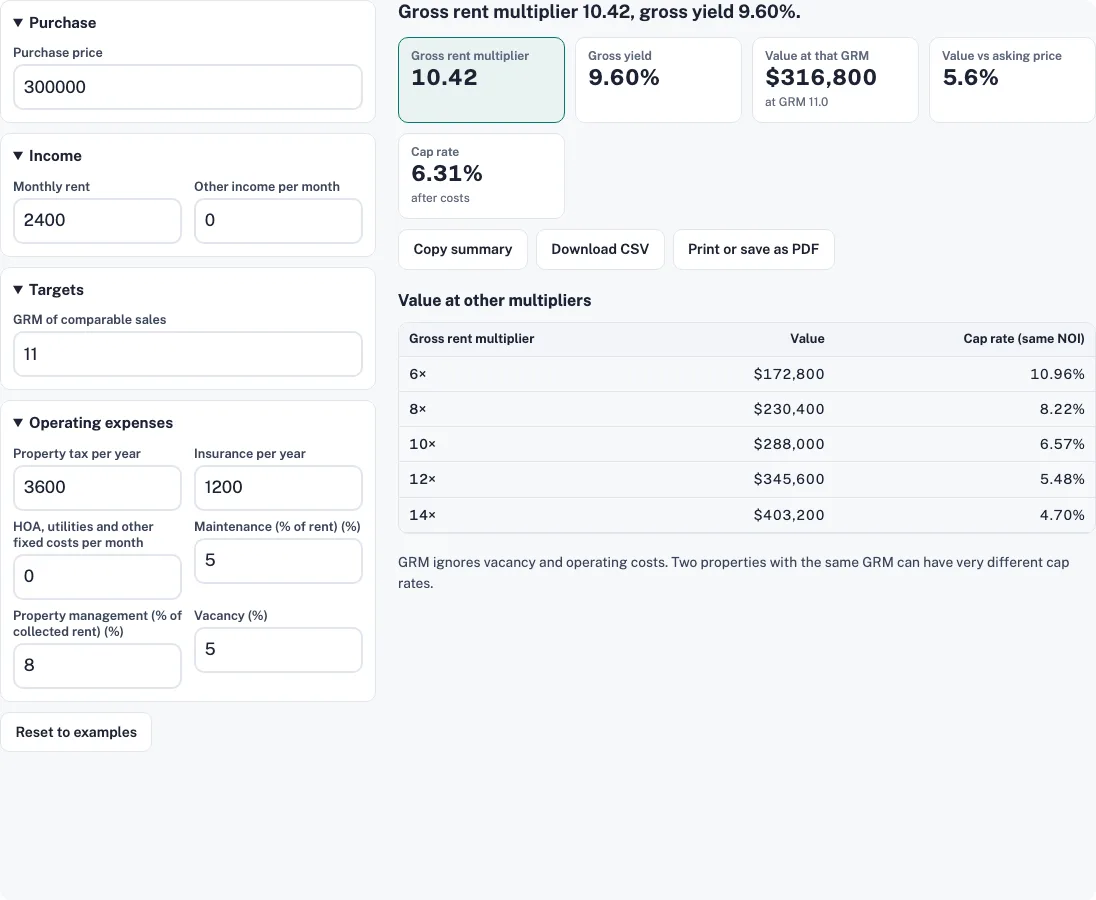
How to use the gross rent multiplier calculator
- Read the example values first. They show how the tool works. They are not market data.
- Enter the Purchase price, for example $300,000.
- Enter the Monthly rent the property earns.
- Enter Other income per month if the property earns more than rent, such as parking or laundry. Use 0 if it does not.
- Enter the GRM of comparable sales, the multiplier that similar sold properties in your area show.
- Enter the Property tax per year and the Insurance per year.
- Enter the HOA, utilities and other fixed costs per month.
- Enter Maintenance (% of rent), Property management (% of collected rent) and Vacancy.
- Read the Gross rent multiplier, Gross yield, Value at that GRM and Cap rate results.
- Compare the value at the GRM with the asking price, using the Value vs asking price result.
The results update live as you type. Reset to examples restores the example values, Copy summary copies the figures, Download CSV saves them as a spreadsheet file, and Print or save as PDF prints the page. The page address holds your inputs, so a link you send recreates the same result.
Change one input at a time to see which result moves. The address bar keeps your inputs, so you can bookmark or share a scenario. Reset to examples restores the example values.
What does the gross rent multiplier measure?
The gross rent multiplier is the price divided by the annual gross rent. In symbols, GRM = price ÷ (monthly rent × 12). The default example has a $300,000 price and $2,400 monthly rent, so annual rent is $28,800 and GRM = $300,000 ÷ $28,800 = 10.42. The gross yield is the inverse, $28,800 ÷ $300,000 = 9.60%. A lower GRM means you pay less for each dollar of rent.
How do you value a property from comparable sales?
Multiply annual rent by the GRM of comparable sales. In the example, the comparables trade at 11 times rent, so the value is $28,800 × 11 = $316,800. That is 5.6% above the $300,000 asking price, because ($316,800 − $300,000) ÷ $300,000 = 5.6%. The result depends on how good the comparables are, so check them before you use the number.
Why two properties with the same GRM can have different cap rates
GRM uses gross rent. It ignores vacancy, taxes, insurance, maintenance and management. Take two properties at $300,000 with $2,400 rent. Both have a GRM of 10.42. Property A has the default costs and a cap rate of 6.31%. Property B has the same price and rent, but its property tax is $7,200 a year, not $3,600, and its insurance is $2,400 a year, not $1,200. Those two changes add $4,800 of cost a year, which lowers the income left after costs from about $18,931 to about $14,131, so B’s cap rate falls to about 4.71% ($14,131 ÷ $300,000). The GRM is the same, but the cap rate is about 1.6 points lower.
The table shows the same effect on one property. Each row keeps the same income and changes only the multiplier.
| Gross rent multiplier | Value | Cap rate (same NOI) |
|---|---|---|
| 6× | $172,800 | 10.96% |
| 8× | $230,400 | 8.22% |
| 10× | $288,000 | 6.57% |
| 12× | $345,600 | 5.48% |
| 14× | $403,200 | 4.70% |
Each step up in the multiplier raises the value and lowers the cap rate on the same net operating income, which is about $18,931 a year here.
What is a good gross rent multiplier?
There is no fixed good number. A good GRM is one that is in line with comparable sales in the same market. Compare the GRM of comparable sales with the GRM of the property you are checking. A lower GRM is cheaper per dollar of rent, but the number alone does not show costs or risk.
Is a higher or lower GRM better?
A lower GRM is better, all else equal, because you pay less for each dollar of rent. It is not better on its own, since two properties can share a GRM and still differ in costs. Read it together with the cap rate and the expenses.
What is a drawback of using GRM?
The main drawback is that GRM ignores vacancy and operating costs. In the default example, the gross yield is 9.60%, but the cap rate after costs is 6.31%. The gap is the costs the GRM does not see. Use the GRM as a quick first check, then run the cost-adjusted measures.
Frequently asked questions
How do you calculate gross rent multiplier?
Divide the purchase price by the annual gross rent, which is the monthly rent times 12. For the default example, $300,000 ÷ $28,800 = 10.42, and the calculator shows the same figure as you type. This tool does the arithmetic as you type, and the explanation below shows each step.
What is the 2% rule for rentals?
The 2% rule is a stricter rent screen: monthly rent should be at least 2% of the price. It is a different test from GRM, so see the 1 percent rule calculator for the rent-to-price screens.
Is a higher or lower GRM better?
A lower GRM is better, all else equal, because you pay less for each dollar of rent. Use it with the cap rate, since costs decide what is left. A low GRM with high costs can still give a weak cap rate, so check both numbers before you compare deals.
What is a drawback of using GRM?
Because GRM leaves out vacancy and operating costs, equal multiples can hide very different cap rates. The example shows a GRM of 10.42 with a cap rate of 6.31%. Check the costs before you rely on the multiplier.
What is the GRM in real estate?
The gross rent multiplier (GRM) is the purchase price divided by the annual gross rent. It shows how many years of rent the price equals before costs. In the default example, $300,000 ÷ $28,800 = 10.42.
What is a good GRM?
There is no fixed good number. A good GRM is one in line with the GRM of comparable sales in the same market, and a lower figure costs less per dollar of rent. Because GRM ignores costs, check the cap rate before you judge a deal.
Can GRM estimate a property’s value?
Yes, roughly. Multiply the annual gross rent by the GRM of comparable sales. In the example, comparables at 11 times rent give $28,800 × 11 = $316,800, which is 5.6% above the $300,000 asking price. The estimate is only as good as the comparables, so check them before you rely on it.
Related tools
- cap rate calculator: use it for the cost-adjusted measure.
- 1 percent rule calculator: use it for rent as a share of price.
- NOI calculator: use it to calculate the expenses GRM ignores.
- rental property calculator: use it for the full model.
- investment property calculator: use it to compare two properties.
- rental income calculator: use it for monthly cash flow.