Cap Rate Calculator
Enter price, rent and expenses to get the cap rate, net operating income and the value of the same income at other cap rates.
Free · runs in your browser · nothing is uploaded
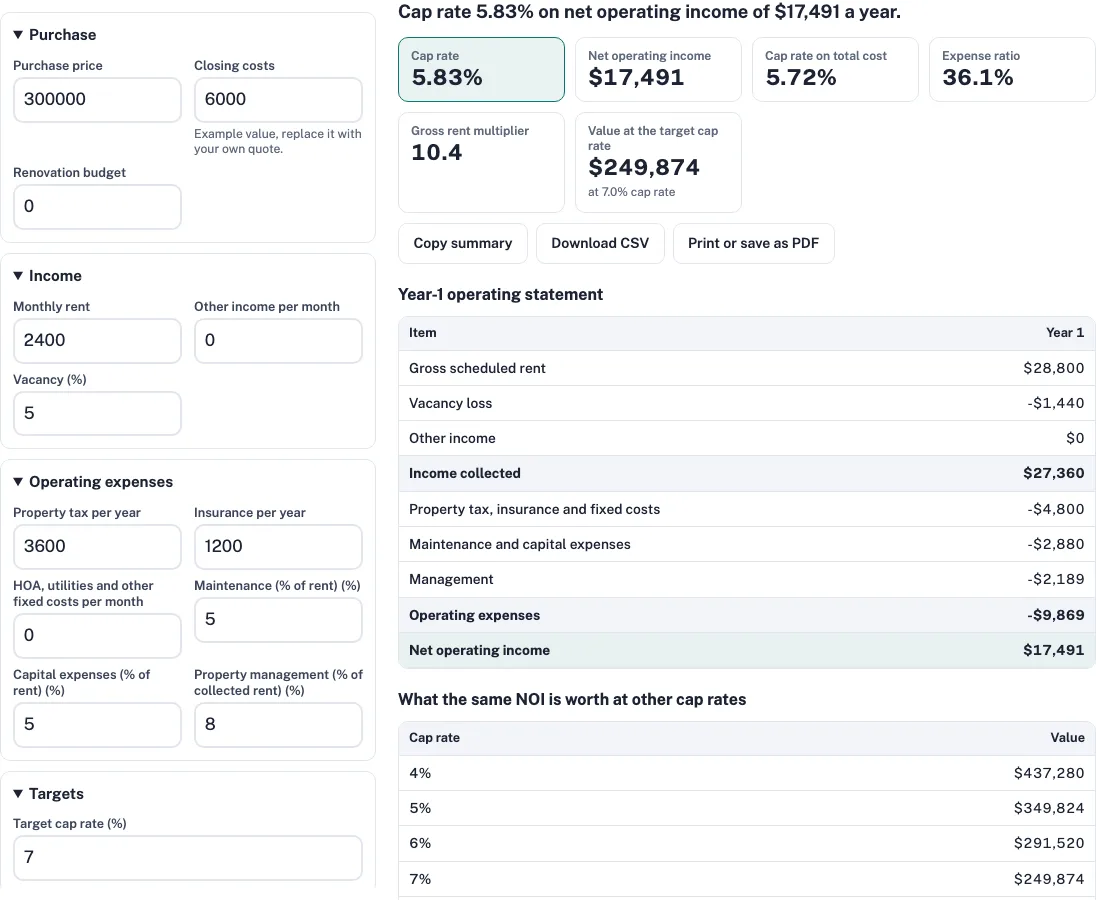
How to use the cap rate calculator
- Enter the Purchase price. The example uses $300,000.
- Enter the Closing costs you expect to pay on top of the price. The example uses $6,000.
- Enter the Renovation budget. The example uses $0, so total cost equals price plus closing costs.
- Enter the Monthly rent you expect when the unit is full. The example uses $2,400.
- Enter Other income per month, such as parking or laundry. The example uses $0.
- Enter Vacancy as a percentage of gross rent. The example uses 5.
- Enter Property tax per year and Insurance per year. The example uses $3,600 and $1,200.
- Enter HOA, utilities and other fixed costs per month. The example uses $0.
- Set Maintenance (% of rent), Capital expenses (% of rent) and Property management (% of collected rent). The example uses 5, 5 and 8.
- Enter a Target cap rate to see the value at that return. The example uses 7.
The example values are defaults the tool opens with, not market data. The results update as you type, and the buttons Reset to examples, Copy summary, Download CSV and Print or save as PDF restore the examples or keep the figures. A link recreates the same result.
Change one input at a time to see which result moves. The address bar keeps your inputs, so you can bookmark or share a scenario. Reset to examples restores the example values.
What is a cap rate and how do you calculate it?
A cap rate is net operating income divided by the purchase price, shown as a percentage. In symbols, cap rate = NOI ÷ price. With NOI of $17,491 a year and a price of $300,000, the cap rate is 5.83%, the headline result in the tool.
What does net operating income include and leave out?
NOI is what the property earns in one year after vacancy and operating costs. Gross rent is $28,800. Vacancy takes off $1,440, leaving $27,360 collected. Operating expenses are $9,869: $4,800 of property tax and insurance, $2,880 of maintenance and capital expenses, and $2,189 of management. Subtract $9,869 from $27,360 and NOI is $17,491.
NOI leaves out loan payments, income tax and depreciation, so the cap rate is a return before financing and tax. The renovation budget does not reduce NOI. It enters only the cap rate on total cost.
Should the cap rate use the price or the total cost?
The cap rate on price divides NOI by the purchase price alone. The cap rate on total cost adds closing costs and the renovation budget first. Total cost here is $300,000 + $6,000 + $0 = $306,000, so the cap rate is $17,491 ÷ $306,000 = 5.72%. The gap is small because renovation is zero.
What is a good cap rate?
No single cap rate is good for every property. A good cap rate depends on the market, the property class and the risk you take on, so compare it with recent sales of similar buildings nearby. What the tool does show is how cap rate and value move together: for the same NOI, a lower cap rate means a higher value, and a higher cap rate means a lower value.
Value of the same income at other cap rates
Value is NOI divided by the cap rate. Turn it around to price an offer: the price that gives a buyer a chosen return is NOI ÷ that return. The table shows the value of the example NOI of $17,491 at eight cap rates.
| Cap rate | Value |
|---|---|
| 4% | $437,280 |
| 5% | $349,824 |
| 6% | $291,520 |
| 7% | $249,874 |
| 8% | $218,640 |
| 9% | $194,347 |
| 10% | $174,912 |
| 12% | $145,760 |
The 7% row is the tool’s target result, $249,874, which sits $50,126 below the $300,000 price. Suppose a seller asks $300,000 and you want a 6% return. The price that gives you 6% is $291,520, which is $8,480 below the ask. The tool uses unrounded NOI, so a hand check with the rounded $17,491 can differ by a few dollars.
How do rent and price changes move the cap rate?
Rows change rent and columns change price. The middle cell, with no change, is the base 5.83%.
| Monthly rent change / price change | Price -10% | Price -5% | Price ±0% | Price +5% | Price +10% |
|---|---|---|---|---|---|
| Rent -20% | 4.83% | 4.57% | 4.34% | 4.14% | 3.95% |
| Rent -10% | 5.65% | 5.36% | 5.09% | 4.85% | 4.62% |
| Rent ±0% | 6.48% | 6.14% | 5.83% | 5.55% | 5.30% |
| Rent +10% | 7.30% | 6.92% | 6.57% | 6.26% | 5.98% |
| Rent +20% | 8.13% | 7.70% | 7.32% | 6.97% | 6.65% |
A 10% rise in rent lifts the cap rate from 5.83% to 6.57%, about 0.74 points. A 10% rise in price lowers it to 5.30%, about 0.53 points. Rent moves the result more here, so check the rent assumption as carefully as the price.
Why does the cap rate ignore financing and growth?
The cap rate uses one year of NOI and the price, so it leaves out the loan. Two buyers with different down payments and interest rates get the same cap rate for the same property. It also leaves out rent increases you expect later and any change in value after you buy.
Frequently asked questions
How do you calculate the cap rate?
Divide one year of net operating income by the purchase price, then express the result as a percentage. For example, $17,491 ÷ $300,000 = 5.83%.
What does a 7.5% cap rate mean?
It means one year of NOI equals 7.5% of the price. On a $2,000,000 price, that is $150,000 of NOI a year.
What is the cap rate if a building sells for $2,000,000 with an NOI of $150,000?
The cap rate is $150,000 ÷ $2,000,000 = 7.5%, before closing and renovation costs are added.
Is a 5% cap rate good?
It depends on the market, the property and your risk. Compare a 5% cap rate with recent sales of similar buildings nearby, since 5% means paying more per dollar of NOI than 7.5% does.
How is NOI defined?
Net operating income (NOI) is the rent you collect in a year, after vacancy, minus the yearly costs of running the property, such as property tax, insurance, maintenance, capital expenses and management. It leaves out loan payments, income tax and depreciation. In the example, $27,360 − $9,869 = $17,491 a year.
Does the cap rate include the mortgage?
No. The cap rate divides one year of NOI by the purchase price, and the loan is not part of that calculation, so two buyers with different loans get the same cap rate. To see the return on your cash after the loan, use the cash on cash return calculator.
What factors influence the cap rate?
The cap rate moves with rent, price, vacancy and every cost you enter, because each one changes NOI or price. In the example, a 10% rise in rent lifts the cap rate from 5.83% to 6.57%, while a 10% rise in price lowers it to 5.30%. Rent moves the result more here, so check the rent assumption as closely as the price.
Related tools
- noi calculator: use it when you need the NOI line by line before you can get a cap rate.
- gross rent multiplier calculator: a quicker screen that ignores costs.
- cash on cash return calculator: once a loan is involved and you care about the return on your cash.
- rental property calculator: for the full cash flow and year-by-year projection.
- 1 percent rule calculator: a fast rent-to-price screen before you do any detailed work.
- cap rate calculator Canada: the same calculation with Canadian dollars and Canadian property cost notes.