Negative Gearing Calculator
Enter rent, interest and costs to see the rental loss, the tax it saves at your rate and the weekly cash flow after tax.
Free · runs in your browser · nothing is uploaded
How to use the negative gearing calculator
- Enter Rent per week from the rent you expect to collect.
- Enter Vacant weeks per year. The tool takes these weeks off the rent.
- Enter Loan interest per year from your loan statement.
- Enter Council and water rates per year, Insurance per year and Property management per year.
- Enter Repairs and maintenance per year and Other costs per year.
- Enter Depreciation or write-off per year. It is a deduction that no money leaves your account for, so the calculator treats it separately.
- Enter Your marginal income tax rate as a percentage. Include the Medicare levy if you want it counted. The tool applies no tax tables, so this rate is the only one it uses.
- Read Rental loss and Tax saved first, then the cash flow before and after tax.
The results update live as you type. The starting figures are examples, not market data or a recommended rate. Reset to examples puts them back, Copy summary and Download CSV save the numbers, and Print or save as PDF prints the page. The page address holds your inputs, so a link recreates the result, and you can share it with your adviser.
Change one input at a time to see which result moves. The address bar keeps your inputs, so you can bookmark or share a scenario. Reset to examples restores the example values.
How does negative gearing work?
Negative gearing describes a rental property where the costs you can deduct are larger than the rent, so the property makes a tax loss. In general terms, that loss can reduce the tax on your other income. The tax rules themselves are not reproduced on this page. The calculator multiplies the rental loss by the rate you enter: tax saved = rental loss × your marginal rate.
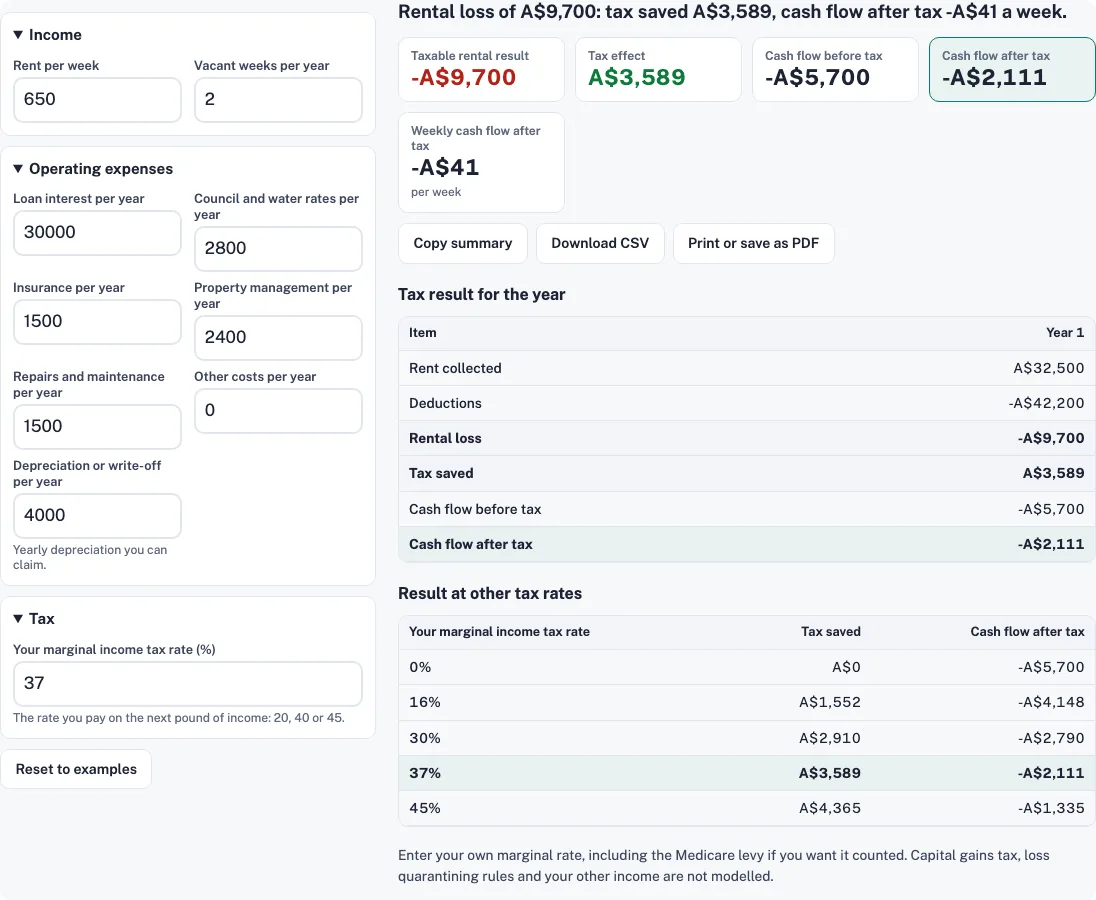
With the example figures, the rental loss is A$9,700 and the rate is 37%, so the tax saved is A$9,700 × 37% = A$3,589.
Out-of-pocket cost before and after tax
The example property collects A$32,500 a year, which is A$650 for 50 paid weeks. Its deductions total A$42,200: loan interest A$30,000, council and water rates A$2,800, insurance A$1,500, property management A$2,400, repairs and maintenance A$1,500, other costs A$0 and depreciation or write-off A$4,000.
Cash flow before tax leaves out depreciation, because it is not paid out. The cash costs are A$38,200, so A$32,500 − A$38,200 = −A$5,700. Adding the tax saved gives the cash flow after tax: −A$5,700 + A$3,589 = −A$2,111, or about −A$41 a week (A$2,111 ÷ 52).
| Item | Year 1 |
|---|---|
| Rent collected | A$32,500 |
| Deductions | -A$42,200 |
| Rental loss | -A$9,700 |
| Tax saved | A$3,589 |
| Cash flow before tax | -A$5,700 |
| Cash flow after tax | -A$2,111 |
What can you claim on an investment property?
The calculator models seven cost lines: loan interest, council and water rates, insurance, property management, repairs and maintenance, other costs, and depreciation or write-off. Whether each cost is deductible for you, and by how much, depends on your own circumstances and the tax rules. Those rules are not reproduced here, so enter only the amounts that apply to you and check the treatment with a registered tax agent.
Is negative gearing worth it?
It depends on your own position. The cash loss is real: the example still loses A$2,111 after tax. The tax saving is a fraction of the loss, and it depends on your rate and your other income, which the calculator does not model. Some investors accept a holding loss because they expect capital growth. Growth is not guaranteed, and the calculator does not model it. A positively geared property, where rent is more than its costs, produces cash income and no tax loss to offset.
Result at other tax rates
The rental loss is the same at every rate. Only the tax saved changes, and each percentage point moves it by A$97 (A$9,700 × 1%). The rates in the table are examples the tool shows, not a list of tax brackets. At 0%, there is no tax saving, so the cash loss is the full A$5,700.
| Your marginal income tax rate | Tax saved | Cash flow after tax |
|---|---|---|
| 0% | A$0 | -A$5,700 |
| 16% | A$1,552 | -A$4,148 |
| 30% | A$2,910 | -A$2,790 |
| 37% | A$3,589 | -A$2,111 |
| 45% | A$4,365 | -A$1,335 |
What does the calculator not model?
The calculator does not model capital gains tax, loss quarantining rules, changes to your other income, or changes in holding costs over time. It does not model capital growth either. Those items can change the result, so treat the output as one year’s estimate. Enter your own rate, with the Medicare levy if you want it counted, and take the figures to a registered tax agent before you decide anything.
Frequently asked questions
How does negative gearing work?
When deductible costs are more than the rent, the property makes a rental loss. The calculator shows the tax saved at your rate and the cash flow before and after that saving.
Is negative gearing worth it?
It depends on your own position, including whether you expect capital growth, which is not guaranteed. The cash loss is still a loss, and the tax saved only covers part of it. A registered tax agent can review your case, using your full income and your actual costs.
What can you claim on an investment property?
The calculator models loan interest, council and water rates, insurance, property management, repairs and maintenance, other costs, and depreciation or write-off. Whether each cost is deductible for you depends on your circumstances and the tax rules, which this page does not reproduce.
Does the calculator apply tax tables?
No. You enter your own marginal rate, with the Medicare levy if you want it counted. The tool multiplies the rental loss by that rate and applies no other tax step.
Is this tax advice?
No. The results are estimates from the figures you enter. Speak to a registered tax agent before you make a decision about a property.
When does negative gearing turn positive?
A property is positively geared when rent covers its costs. With the other inputs unchanged, the rent would need to reach A$764 a week for cash flow before tax to reach zero (A$38,200 of cash costs ÷ 50 paid weeks). The calculator does not model rent growth, so it cannot show when that would happen.
How does negative gearing affect my tax refund?
The calculator does not work out a refund. It shows tax saved as the rental loss times your marginal rate: A$9,700 × 37% = A$3,589 in the example. Your actual refund depends on your full tax return, which this tool does not model.
How do capital gains fit in?
They sit outside this calculator. It does not model capital gains tax, capital growth or a sale, so it shows one year of rental loss, tax saved and cash flow. Take any sale figures to a registered tax agent.
Related tools
- rental yield calculator: use it to see yield before tax.
- rental property calculator: use it for a projection with growth.
- cash on cash return calculator: use it to see the return on your cash.
- DSCR calculator: use it to check loan coverage.
- cap rate calculator: use it to see the unlevered return.
- BRRRR calculator: if you plan to renovate and refinance.