Investment Property Calculator Australia
Enter price, rent, loan and costs in dollars to see cash flow, yield and a year-by-year projection with sale.
Free · runs in your browser · nothing is uploaded
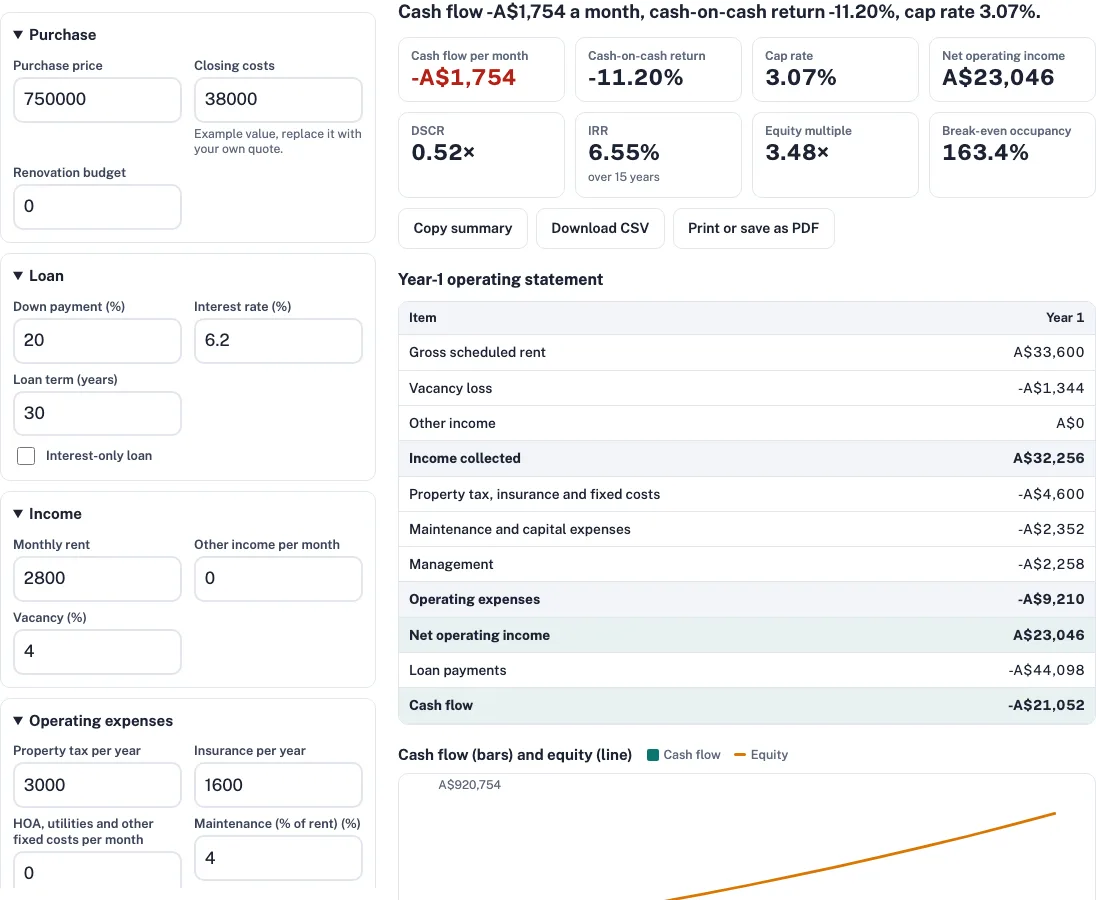
How to use the investment property calculator Australia
- Enter the Purchase price. The example is A$750,000.
- Enter Closing costs with your own stamp duty and land tax. No state rate is applied, so A$38,000 is only an example.
- Enter the Renovation budget and Down payment (%). The examples are 0 and 20.
- Enter the Interest rate, Loan term (years) and Interest-only loan. The examples are 6.2, 30 and no.
- Enter the Monthly rent, Other income per month and Vacancy (%). The examples are A$2,800, 0 and 4.
- Enter Property tax per year, Insurance per year and HOA, utilities and other fixed costs per month. The examples are A$3,000, A$1,600 and 0.
- Enter Maintenance (% of rent), Capital expenses (% of rent) and Property management (% of collected rent). The examples are 4, 3 and 7.
- Enter Rent growth per year, Expense growth per year and Value growth per year, which are assumptions.
- Enter Selling costs (%) and Years you hold it. The examples are 2.5 and 15.
- Leave Income tax rate on profit (0 = ignore tax) at 0 for a before-tax result.
The results update as you type. Reset to examples, Copy summary, Download CSV and Print or save as PDF restore the examples, copy the summary, save the figures as CSV and make a printable page. Your inputs sit in the page address, so a link recreates the result.
Change one input at a time to see which result moves. The address bar keeps your inputs, so you can bookmark or share a scenario. Reset to examples restores the example values.
How do you calculate investment property returns in Australia?
Start with rent. Take off vacancy to get income collected. Take off operating expenses to get Net operating income. Take off loan payments to get Cash flow. In the example, A$33,600 of rent less 4% vacancy (A$1,344) gives A$32,256 collected. Operating expenses of A$9,210 leave A$23,046 of net operating income, and loan payments of A$44,098 leave a cash flow of -A$21,052 a year, or -A$1,754 a month.
Two ratios follow from these figures. The cap rate is net operating income divided by price: A$23,046 / A$750,000 = 3.07%. Cash-on-cash return is cash flow divided by cash put in. Here that is the down payment of A$150,000 plus closing costs of A$38,000, which is A$188,000. So -A$21,052 / A$188,000 = -11.20%.
What costs should I include on an investment property?
Include every cost you expect to pay: closing costs, renovation, vacancy, property tax, insurance, fixed costs, maintenance, capital expenses, management, loan payments and selling costs. The tool counts maintenance and capital expenses as a percentage of rent, and management as a percentage of rent collected. Stamp duty and land tax depend on your state, so check them with the official source for that state and with your quotes.
Year-by-year projection in Australian dollars
The projection grows rent and costs each year, reduces the loan balance and shows the equity you hold. Equity is value minus loan balance. In year 1, A$780,000 minus A$592,903 is A$187,097.
| Year | Income collected | Net operating income | Loan payments | Cash flow | Loan balance | Value | Equity |
|---|---|---|---|---|---|---|---|
| 1 | A$32,256 | A$23,046 | A$44,098 | -A$21,052 | A$592,903 | A$780,000 | A$187,097 |
| 2 | A$33,224 | A$23,737 | A$44,098 | -A$20,360 | A$585,353 | A$811,200 | A$225,847 |
| 3 | A$34,220 | A$24,450 | A$44,098 | -A$19,648 | A$577,321 | A$843,648 | A$266,327 |
| 14 | A$47,369 | A$33,844 | A$44,098 | -A$10,254 | A$446,822 | A$1,298,757 | A$851,935 |
| 15 | A$48,790 | A$34,859 | A$44,098 | -A$9,239 | A$429,954 | A$1,350,708 | A$920,754 |
| Sale at the end of year 15 | A$886,986 | A$1,350,708 |
The sale figure is value minus selling costs minus loan balance. At 2.5% of A$1,350,708, selling costs are A$33,768, so A$1,350,708 - A$33,768 - A$429,954 = A$886,986. Rows for years 4 to 13 are not shown here, but the tool calculates them.
What does a negative or positive monthly cash flow mean?
A negative monthly cash flow means the property takes money from you after rent, costs and loan payments are paid. The example is -A$1,754 a month. A positive figure means the property adds money after all of these. Cash flow is before the tax effect unless you enter a tax rate.
How do DSCR and break-even occupancy work?
DSCR is net operating income divided by loan payments: A$23,046 / A$44,098 = 0.52×. A value of 1.0× means income exactly covers the loan payments. Lenders set their own minimums, so check them with your lender. Break-even occupancy is the share of rent you would need to collect to cover costs and the loan. The example shows 163.4%. A figure above 100% means that even full occupancy at these inputs would not cover the costs and the loan.
How do price and rent changes affect cash-on-cash return?
The table moves the rent and the price in steps. Every cell is negative, so no combination in the grid makes cash flow positive. The best cell is rent up 20% with the price down 10%, which gives -6.4%. The example sits in the middle at -11.2%.
| Rent change (rows) / price change (columns) | Purchase price -10% | Purchase price -5% | Purchase price ±0% | Purchase price +5% | Purchase price +10% |
|---|---|---|---|---|---|
| Monthly rent -20% | -12.8% | -13.5% | -14.1% | -14.7% | -15.3% |
| Monthly rent -10% | -11.2% | -12.0% | -12.7% | -13.3% | -13.9% |
| Monthly rent ±0% | -9.6% | -10.4% | -11.2% | -11.9% | -12.5% |
| Monthly rent +10% | -8.0% | -8.9% | -9.7% | -10.5% | -11.2% |
| Monthly rent +20% | -6.4% | -7.4% | -8.3% | -9.1% | -9.8% |
What is the highest price that still works?
The tool also solves for the highest price at which each target holds, with all other inputs unchanged.
| Target | Highest price |
|---|---|
| Highest price for an 8% cap rate | A$288,076 |
| Highest price for an 8% cash-on-cash return | A$267,472 |
| Highest price for a DSCR of 1.25 | A$313,568 |
These figures sit well below the A$750,000 example, so the example price does not meet these targets. They are results of your inputs, not a recommendation.
Where does negative gearing fit?
This page leaves out the tax effect of a rental loss. The negative gearing calculator takes your marginal tax rate and shows that effect. Capital growth in this tool is an input, not a forecast. Nothing on this page is financial, tax or legal advice, so check the figures with a qualified adviser.
Frequently asked questions
How do you calculate investment property returns in Australia?
Subtract vacancy and operating costs from rent to get net operating income, then divide by price for the cap rate. Subtract loan payments to get cash flow, then divide by cash put in for cash-on-cash return. The example gives a 3.07% cap rate and -11.20% cash-on-cash return.
What costs should I include on an investment property?
Include closing costs, renovation, vacancy, property tax, insurance, fixed costs, maintenance, capital expenses, management, loan payments and selling costs. Stamp duty and land tax depend on your state, so take them from the official source for that state.
What does a negative monthly cash flow mean?
It means the property needs money from you each month after rent, costs and loan payments. The example shows -A$1,754 a month before any tax effect. A positive figure means the property adds money after all payments, which is the result to look for when you compare properties.
Does this calculator include negative gearing tax?
No. The tax effect of a rental loss is outside this tool. Use the negative gearing calculator for that, with your own marginal tax rate. Check the result with a qualified adviser before you rely on it.
What is a good rental yield in Australia?
This tool sets no benchmark. Its example gives a cap rate of 3.07% from the inputs entered, and a good figure depends on the city and property type. Compare the same measure for similar properties in the same area.
How do you calculate rental yield?
Gross rental yield is the annual rent divided by the price. For the example, A$2,800 × 12 = A$33,600, and A$33,600 ÷ A$750,000 = 4.48%. The tool’s cap rate of 3.07% is lower because it divides net operating income, after vacancy and operating costs, by the price.
How are loan repayments calculated?
The tool works out the loan payments from the loan amount, the interest rate and the loan term. In the example, a 6.2% rate over 30 years gives loan payments of A$44,098 a year, about A$3,675 a month, and the same payment appears in every year of the projection. Tick Interest-only loan to see how the payments change when no principal is repaid.
Related tools
- rental yield calculator Australia: use it for yield based on weekly rent.
- negative gearing calculator Australia: use it for the tax effect of a rental loss.
- rental property calculator: use it for the general version of this projection.
- investment property calculator: use it to compare two properties.
- DSCR calculator: use it to check whether income covers the loan.
- cash on cash return calculator: use it for the return on the cash you put in.