1 Percent Rule Calculator
Check whether monthly rent reaches 1% of the price, and see the 2%, 50% and 70% rules on the same numbers.
Free · runs in your browser · nothing is uploaded
How to use the 1 percent rule calculator
- Read the example values first. They show how the tool works. They are not market data.
- Enter the Purchase price you are considering, for example $300,000.
- Enter the Renovation budget. Use 0 if the property needs no work. The 1 percent test counts repairs as part of the price.
- Enter the After-repair value (ARV), the value you expect after repairs. It drives only the 70 percent rule.
- Enter the Monthly rent you expect the property to earn.
- Enter the Down payment as a percentage of the price.
- Enter the Interest rate as an annual percentage, for example 6.5%.
- Enter the Loan term (years) of the mortgage.
- Read the headline sentence and the Rules of thumb table. Each rule shows Pass or Fail and the rent or offer it needs.
- Compare the highest price for the 1% rule with your asking price. If the asking price is above it, the rule fails at that rent.
The results update live as you type. Reset to examples restores the example values, Copy summary copies the figures, Download CSV saves them as a spreadsheet file, and Print or save as PDF prints the page. The page address holds your inputs, so a link you send recreates the same result.
Change one input at a time to see which result moves. The address bar keeps your inputs, so you can bookmark or share a scenario. Reset to examples restores the example values.
What does the 1 percent rule measure?
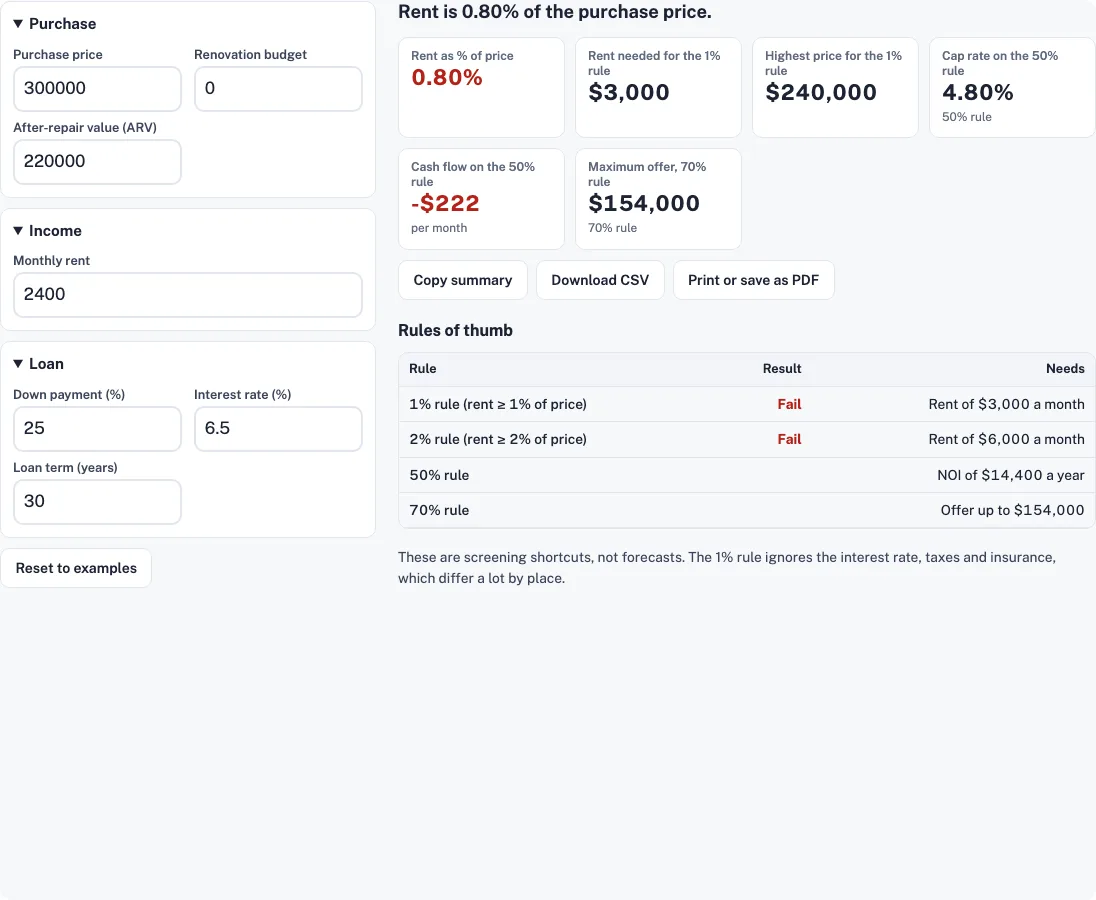
The 1 percent rule asks whether monthly rent is at least 1 percent of the price, including repairs. In symbols, rent ÷ price ≥ 0.01. The default example has rent of $2,400 on a $300,000 price, so rent is 0.80% of the price. That is below the line, so the example fails.
How do the 2%, 50% and 70% rules work?
This table uses the default inputs.
| Rule | How it is tested | Default example |
|---|---|---|
| 1% rule | Rent at least 1% of price | Fail. Needs $3,000 a month |
| 2% rule | Rent at least 2% of price | Fail. Needs $6,000 a month |
| 50% rule | Expenses about half of rent, before the loan payment | NOI of $14,400 a year, cap rate 4.80%, cash flow -$222 a month |
| 70% rule | After-repair value × 70%, minus repairs | Offer up to $154,000 |
The 50 percent rule assumes operating costs take about half the rent before the loan payment. Half of $2,400 is $1,200 a month, or $14,400 a year. Dividing $14,400 by $300,000 gives the 4.80% cap rate. The cash flow figure then subtracts the loan payment. Working backwards, the loan payment behind the -$222 result is $1,422 a month ($1,200 + $222).
The 70 percent rule is for flips. The maximum offer is the after-repair value times 70 percent, minus repairs. With an after-repair value of $220,000 and a renovation budget of $0, the maximum is $220,000 × 70% = $154,000.
The rules of thumb on the same numbers
The default property asks $300,000 and earns $2,400 a month. The 1 percent and 2 percent rules fail, the 50 percent rule shows -$222 a month, and the 70 percent rule caps the offer at $154,000 on a $220,000 after-repair value.
The 1 percent rule passes exactly when rent equals 1% of price, so this table changes only the rent.
| Monthly rent | Rent as % of $300,000 | 1% rule |
|---|---|---|
| $2,400 | 0.80% | Fail |
| $3,000 | 1.00% | Pass |
What price does the 1 percent rule support?
The highest price is rent ÷ 1%. At $2,400 rent, that is $2,400 ÷ 0.01 = $240,000. The $300,000 asking price is $60,000 above that ceiling.
Is the 1 percent rule still realistic?
It depends on the market. In high-price markets, rents rarely reach 1 percent of the price, so the rule fails many properties that may still work for a buyer. Enter local rents and prices to check your own area.
Is 1 percent a month the same as 12 percent a year?
Only as simple multiplication: 1 percent times 12 months is 12 percent. That figure is gross. It counts rent before vacancy, repairs, taxes, insurance, management and the loan payment, so it is not a yield you keep. Cap rate and cash-on-cash return show returns after costs.
What do these rules leave out?
They leave out the interest rate, taxes, insurance, vacancy and local costs. The rules are rules of thumb passed between investors, not laws. The calculator’s own note says the same: these are screening shortcuts, not forecasts. Use them to sort deals quickly, then run the full model before you decide.
How should you use the highest price when making an offer?
Use the highest price as a ceiling for the screen, not as a bid. At $2,400 rent, a price above $240,000 fails the 1 percent test. For a flip, the 70 percent rule gives a separate ceiling, $154,000 on this example.
Frequently asked questions
Is the 1 percent rule still realistic?
It depends on the market. In high-price markets few rentals reach 1 percent of the price, so the rule fails many deals that can still work. Compare the rent you can get locally with the price before you rely on the screen.
Is 1 percent a month the same as 12 percent a year?
Only as simple multiplication. The 1 percent figure is gross, before vacancy, repairs, taxes, insurance and loan payments, so it is not a yield you keep.
What is the 2 percent rule for rentals?
The 2 percent rule is stricter. Monthly rent should be at least 2 percent of the price, which is $6,000 a month on the $300,000 example. The default rent of $2,400 fails it.
What if my rent is just under 1 percent?
A result just under 1 percent is a near miss, not a clear pass. Check the costs the rule ignores before you decide, because taxes, insurance and vacancy can change the answer. Run the full rental property calculator with the real numbers.
How does the 70 percent rule work for house flipping?
The maximum offer is the after-repair value times 70 percent, minus repairs. In the example, $220,000 × 70% = $154,000 with a renovation budget of $0. It is a folk screen, so confirm the sale price, repair costs and holding costs for a real flip.
What is the 1% rule in real estate?
The 1% rule is a quick screen that asks whether a rental’s monthly rent is at least 1 percent of its price, including repairs. In symbols, rent ÷ price ≥ 0.01. It is a rule of thumb for sorting deals, not a measure of profit.
How do I calculate the 1% rule?
Divide the monthly rent by the price, then compare the result with 1 percent. The default example has $2,400 rent on a $300,000 price, so $2,400 ÷ $300,000 = 0.80%, which fails. Turn the formula around to find the highest price the rule supports: $2,400 ÷ 0.01 = $240,000.
How accurate are the calculators?
The arithmetic is exact for the numbers you enter, but the 1 percent, 2 percent, 50 percent and 70 percent rules are screens. They leave out interest, taxes, insurance and local costs, so a pass does not show that a deal will make money. Use the results to sort deals, then run a full model with real figures.
Related tools
- rental property calculator: use it to test a deal that passes the screen.
- gross rent multiplier calculator: use it for a related price-to-rent ratio.
- BRRRR calculator: use it for flips and refinances.
- cap rate calculator: use it for the real return after costs.
- rental income calculator: use it to find the rent you need.
- cash on cash return calculator: use it for the return on your cash.